
Stronghold 4 Economy Guide: Food, Taxes, Honor
Quick answer
Start the Stronghold 4 economy with wood: place woodcutters directly against the trees, expand your stockpile up to six times, and get that timber flowing before anything else. Once wood is steady, add stone and iron, then layer in food chains, honor and taxes. That is the loop Firefly Studios demonstrates in its official castle customization and economy video, and it is the order the current demo pushes you through.
| Stockpile expansion | The stockpile can be expanded up to six times, and clicking the same tile places an adjacent stockpileStronghold 4 - Castle Customization & Economy (Firefly Studios) |
|---|---|
| Bread chain | Wheat farm, then mill (wheat to flour), then bakery (flour to bread)Stronghold 4 - Castle Customization & Economy (Firefly Studios) |
| Honor sources | An intact keep and lavish banquets prepared in the lord's kitchen earn honor; each rank unlocks economy and military contentStronghold 4 - Castle Customization & Economy (Firefly Studios) |
| Release | Early Access launch on Steam on December 7, 2026; an economic campaign arrives in the 1.0 version after roughly six months of Early AccessStronghold 4 on Steam |
| Weather effect | Snow hinders crop growth, so food output can drop seasonallyStronghold 4 on Steam |
The Stronghold 4 economy explained: build your stockpile and food chains, balance taxes and honor, and keep peasants fed so your castle can grow.
Table of Contents
Start the Stronghold 4 economy with wood: place woodcutters directly against the trees, expand your stockpile up to six times, and get that timber flowing before anything else. Once wood is steady, add stone and iron, then layer in food chains, honor and taxes. That is the loop Firefly Studios demonstrates in its official castle customization and economy video, and it is the order the current demo pushes you through.
How the system fits together
The economy is chains, not piles. A worker chops wood, wood becomes housing and workshops, workshops become weapons, food stabilizes popularity, taxes become gold, and gold funds defense. Economy mistakes often look like military mistakes: late walls, missing archers or stalled repairs usually trace back to worker count, food pressure, storage placement or overbuilding.
Keep eight things in view as you play: starting resources, worker count, building cost, production time, storage distance, food stability, tax pressure, and the point where growth can safely shift into defense.
Early build order
Plan before you place the stockpile
Firefly's own walkthrough warns that bad planning causes a domino effect: too few woodcutters stalls construction, no flour shuts the bakery, minimal iron leaves swordsmen unarmed. Use the in-game build area indicator to see the edges of your territory before committing.
Place woodcutters near trees
Woodcutters are the heartbeat of the start. Put them close to the treeline for maximum hauling efficiency and build several — the June demo player found himself chronically short of wood whenever weapon workshops came online.
Expand the stockpile
Every resource flows into the stockpile, which can be expanded up to six times. A new quality-of-life feature lets you click the same tile to place additional stockpiles adjacent to it; the same trick works for most industry and farm buildings. Extra stockpiles must be placed near an existing one. It stores raw materials (wood, iron, stone, pitch) and industry goods (wool, wheat, flour, hops, ale, candles).
Add stone and iron
Stone quarries must sit on stone deposits and are served by one or more oxen that haul stone straight to the stockpile — this is your path to towers and walls. Iron mines must likewise be placed on iron deposits; iron feeds advanced weapon production.
Feed your peasants
Start with apple orchards and turnip patches: cheap, dependable staples that keep the granary stocked, though their yields are modest. Later, build the bread chain — a wheat farm running a five-stage cycle, a mill where workers grind wheat into flour, and a bakery that turns flour into bread. Cheese from dairy farms and cheese workshops adds variety.
Build housing and upgrade it
Hovels come first; you can spend wood to upgrade them into better houses, which the demo player found worth doing across the whole settlement. Inadequate shelter drags popularity down, while higher-quality housing raises your honor — so balance cost against quality.
Taxes, popularity and the fear factor
Popularity is the lever that turns stability into gold. When happiness is positive, more settlers arrive and you can raise taxes; the demo player repeatedly bumped the tax rate after favorable events pushed public order up. Two series staples modify this:
- Fear factor (cruel side): gallows and gibbets make peasants work harder, but the productivity boost weakens your soldiers in battle.
- Good lord side: benches, statues, gardens and dovecotes keep peasants happy and loyal at a cost to production speed.
The payoff for high popularity is a financial buffer: peasants tolerate a heavier tax burden without grumbling, funding your next expansion. In-game events — a holy turnip, a nasty flu, an ale-drinking competition, a drunk priest — pop up in the top-right corner and swing popularity sharply in either direction, so check them before touching the tax slider.
Honor and the lord's kitchen
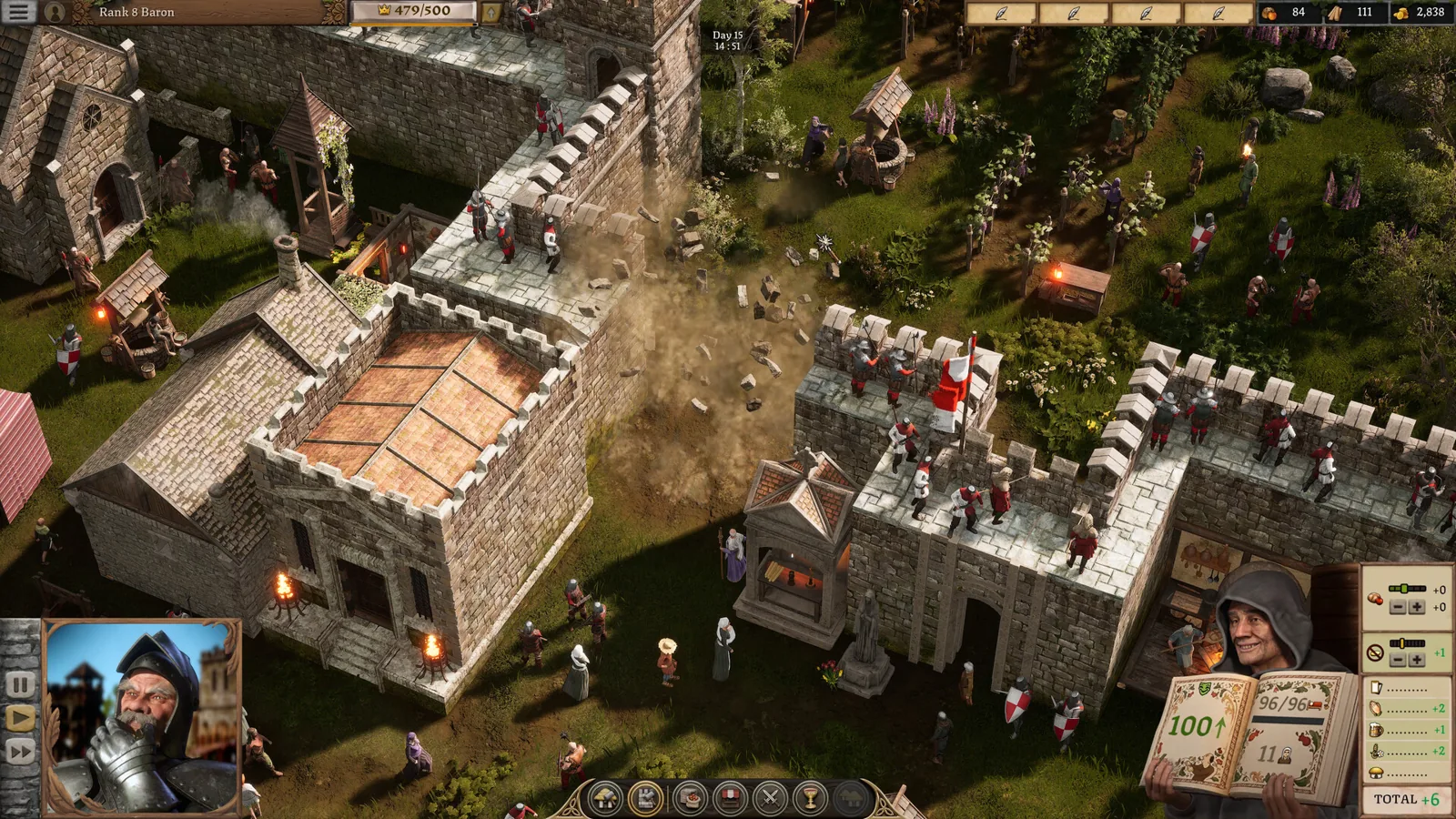
Honor is the progression currency. You earn it from simply having an intact keep and from holding banquets, and each rank in the honor panel unlocks both economy and military content — the demo player made a habit of ranking up as soon as it was available, since it only adds building access.
The centerpiece is the lord's kitchen, where meals from a simple sweet treat to a king's banquet are prepared for feasts in the keep. Each meal needs a different mix of ingredients — wine, honey, boar or deer — produced at their own buildings. The beekeeper station shows how tightly this is woven in: you choose between honey for honor-boosting feasts or candles for shrines and churches, which boost popularity instead.
That trade-off defines the system: higher honor and unit unlocks versus higher popularity and better taxes. Skimp on honor and you may defend your keep with "a smattering of measly, unmotivated archers," as Firefly puts it.
Supply-chain placement checklist
- Woodcutters adjacent to forests.
- Stone quarries on stone deposits, with oxen assigned for hauling.
- Iron mines directly on iron veins.
- Animal farms in open fields with direct paths to stockpiles and processing buildings.
- Food production connected to granaries by short, unobstructed routes.
- Related industries grouped together to cut travel time.
Use Free Build (including the record-sized Highland Coast map in demo 2) to test layouts before campaign or skirmish.
Next steps
- Need gold specifically? Our page on how to get gold in Stronghold 4 covers tax rates and income timing in more detail.
- Rehearse layouts in the demo: the current Steam demo includes Free Build and Skirmish mode, the cheapest way to test supply chains before the December 7 launch.
FAQ
How do I grow my population?
Keep a food surplus, build enough housing, and maintain honor. Well-fed peasants with adequate shelter and an honorable lord attract more settlers; happiness in the demo directly drove population inflow.
What happens when peasants starve or get unhappy?
Firefly's video shows the failure state plainly: the granary empties and peasants leave the castle, leaving buildings unmanned. Sustained unhappiness means lost productivity, desertion and eventually unrest.
How does the Stronghold 4 economy handle weather?
Snow hinders crop growth, cutting farm yields, so maintain reserves and diversified food sources. Heavy rain reduces archery range, which affects defense planning rather than production directly.
Should I prioritize honor or popularity?
They trade off through choices like the beekeeper's honey-versus-candles decision and housing quality. Honor unlocks economy and military ranks; popularity sustains taxes and growth. In a rush scenario, favor popularity for tax income; for long scenarios, invest in feasts and honor buildings to unlock the stronger units.
Check note: facts above come from Firefly Studios' official economy video and the official Steam store page (release date, Early Access scope, snow effect), plus the demo first-look video for build-order details. Market/trade mechanics, drought behavior, and exact building costs and yields remain unconfirmed.
Related guides for this game
Economy Guides Index
Stronghold 4 How to Get Gold: Taxes and Market Sales
Learn Stronghold 4 how to get gold by taxing your peasants and selling surplus goods at the market, with tips from the demo build.
Guide Guides Index
Stronghold 4 Castle Building Guide: Layout, Defense, Economy
This Stronghold 4 castle building guide explains layout, defense and economy principles so you can plan walls, food, taxes and sieges with confidence.

Stronghold 4 Beginner Guide: First Steps and Demo Start
This Stronghold 4 beginner guide walks new players through the free demo, first economy buildings, taxes, defense basics and the modes worth learning first.
Stronghold 4 Castle Customization: Pieces & Cosmetics Guide
Stronghold 4 castle customization explained: use castle pieces and cosmetics, rank up, and test layouts risk-free in the Free Build demo mode today.
Stronghold 4 Mission Guide: 22-Mission Campaign Playthrough
This Stronghold 4 mission guide explains the 22-mission campaign structure and what to play before the December 7, 2026 launch.
Modes Guides Index
Stronghold 4 Economic Mission: Economy Strategy Guide
How to win a Stronghold 4 economic mission: build food security first, balance taxes and honor, weather-proof your farms, and finish the mission checklist.